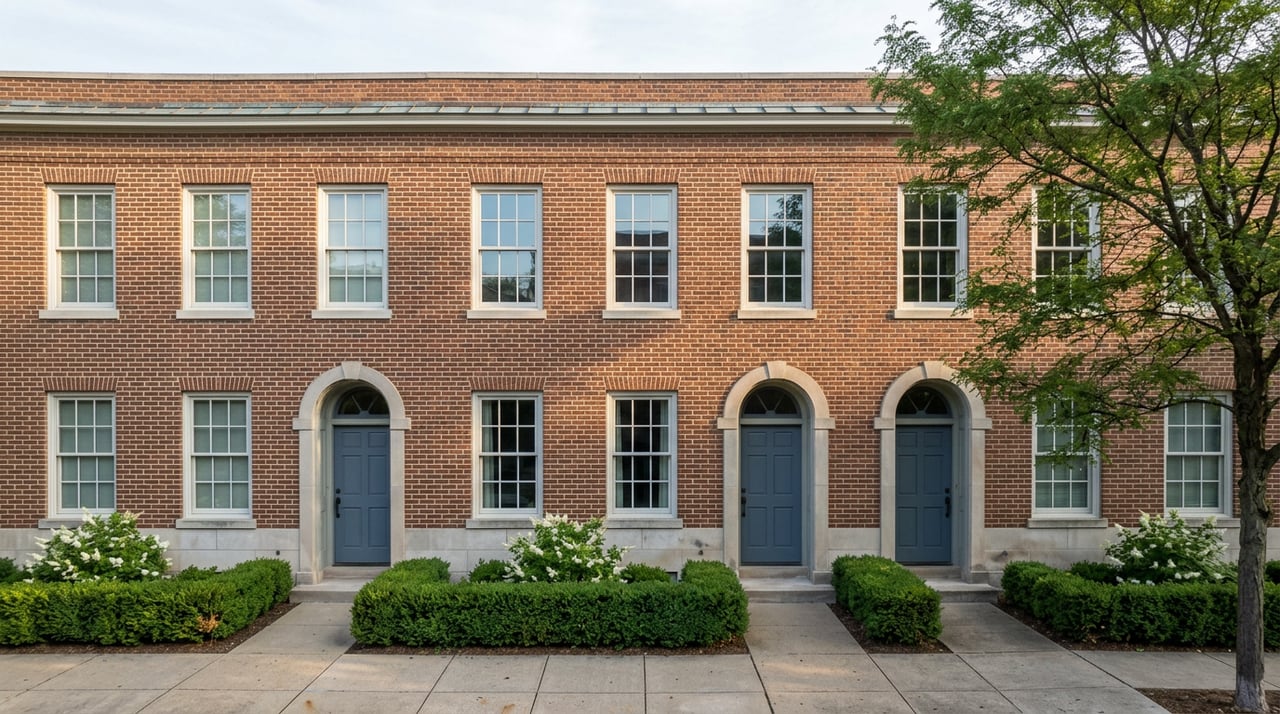
Crews hit a buried storage tank on East Burlington Avenue on May 1, 2026. It sat directly in the path where the village needed to relocate a water main and storm sewer, and it stopped a road realignment project cold for two weeks while permits caught up with the discovery. The tank came out on May 14. Work resumed a few days later.
That delay is a footnote in the life of one Westmont street. But the project it interrupted is not a footnote at all. The village was not simply repaving East Burlington between Cass and Linden. It was moving the road's long-standing "S-curve" about 150 feet east, on purpose, so that the parcels on the northeast corner of Cass and Burlington could be assembled into something bigger than what currently sits there. Roads do not usually get bent for no reason. This one got bent because the village wants that corner redeveloped, and a straighter street makes the land beneath it more useful to a builder.
If you are shopping listings in downtown Westmont right now, or thinking about selling a home two blocks from that intersection, the road project is the visible part of a much larger shift. The invisible part happened a year earlier, in a Village Board meeting most residents never watched.
A Downtown That Stopped Being One District
For decades, downtown Westmont was governed as a single zoning district: B-1. One set of rules applied whether a building sat directly across from the train platform or three blocks out along a quiet residential stretch. On August 7, 2025, the Village Board voted to end that. The comprehensive zoning ordinance rewrite split downtown into three legally distinct districts, each with its own rules for height, density, and permitted use.
Community Development Director Joe Hennerfeind put the reasoning plainly when the village announced the change was moving toward implementation: the goal was to acknowledge that Westmont's downtown, small as it is, is not one uniform place. The new framework, he said, would put density where it makes sense, near the train tracks, while treating the residential stretches along Burlington Avenue and Quincy Street differently.
Here is what that actually created:
| District | What it covers | What it allows |
|---|---|---|
| B-1(A) Downtown Core | Cass Avenue between Richmond and Norfolk Streets, plus roughly one block off Cass along Burlington and Quincy | The village's highest-intensity mixed-use zoning, aimed at retail-with-housing-above near the station |
| B-1 Downtown Edge | The village's newsflash identifies it as the former B-1 Limited Business district. | A lower-intensity commercial tier for the blocks just outside the core |
| R-7 Downtown Residential | Properties currently zoned R-5 along the railroad corridor | A district built specifically to incentivize new row homes, replacing the wider range of uses R-5 allowed |
The Planning & Zoning Commission held its public hearing on the specific parcel-by-parcel rezoning into these three districts on June 10, 2026, at Village Hall, with a recommendation then heading to the Village Board for final action. The R-7 rezoning FAQ the village distributed to affected property owners is direct about the intent: the Comprehensive Plan adopted back in 2013 identified the railroad corridor as appropriate for attached housing, and the R-7 district exists to push those specific lots toward row home construction rather than the mix of single-family and multi-unit uses R-5 permitted.
Why This Matters More Than Whatever the Portal Says
A median sale price for "downtown Westmont" was always a blend. Now it is a blend of three legally different products. A lot inside the B-1(A) Core can differ from a nearly identical-looking lot one block into R-7: the R-7 parcel has a clear incentive structure written into it for row home construction.
This is the part a portal search cannot show you. Two listings can look interchangeable in photos, similar in square footage, similar in list price, and sit on opposite sides of a zoning line. One might be a candidate for a builder to assemble alongside its neighbors, the way the village itself is currently preparing the Cass and Burlington corner for exactly that outcome.
The village is not just writing rules on paper. It is spending capital to make the rules real. The East Burlington realignment is village money, budgeted for fiscal year 2026, moving a public road specifically to make private redevelopment of an adjacent corner more feasible. That is a different signal than a zoning map alone. It tells you where the village expects the next building to go up, not just where it would technically be allowed.
The zoning ordinance keeps moving too. On May 28, 2026, the Village Board approved a further text amendment allowing accessory video gaming in both the B-1(A) and B-1 Edge districts, a small change but a reminder that these three downtown categories are still being actively shaped, not frozen in place from last August.
What To Actually Check Before You Treat Two Listings As Comparable
If you are comparing a Westmont property against something else on your list, or preparing to list one yourself, the zoning district a specific parcel sits in now matters as much as the number on the sign out front. A few things worth confirming before you assume two downtown addresses are playing by the same rules:
- Which of the three districts, B-1(A), B-1 Edge, or R-7, actually applies to the parcel, not just the general "downtown Westmont" label
- Whether the property falls within the Downtown Westmont TIF District; separately, the village's Downtown Incentive Program offers matching grants up to $100,000 for facade work, signage, accessibility upgrades, and fire suppression systems, with priority given to businesses along Cass Avenue between Naperville Road and Dallas Street
- Whether nearby village capital projects, like the Burlington realignment, are quietly signaling where redevelopment interest is concentrated
- Whether the parking supply near a listing matters to your plans. Downtown Westmont currently has more than 460 free public parking spaces within two blocks of Cass and Burlington, including a 60-space lot at Cass and Burlington itself and over 150 spaces at the West Quincy commuter lot, a detail that affects both livability and how a mixed-use redevelopment might be designed around existing supply
None of this shows up in a standard comparable sales pull. It shows up in the village's own zoning documents and meeting records, which is exactly why it gets missed.
A Few Questions Worth Settling
Does the zoning change affect homes that are already single-family, not just commercial buildings? Yes, for properties inside the R-7 boundary. Those parcels were previously zoned R-5, which permitted a range of uses from single-family detached homes to multi-unit buildings. The R-7 designation narrows that range and is specifically written to encourage row home construction going forward.
Is the East Burlington construction finished? The village targeted completion for summer 2026, with the May storage tank discovery adding roughly two weeks to the schedule. Current status is worth confirming directly with the village's construction updates page before assuming the road is fully reopened.
Does a property being in the B-1(A) Core automatically mean it will be redeveloped? No. Zoning sets what is legally allowed, not what will happen. A B-1(A) designation makes mixed-use redevelopment possible on a given lot. Whether an owner or a builder pursues that is a separate decision, shaped by market conditions and individual property assembly, the same way the Cass and Burlington corner project has been discussed for years before infrastructure work actually began.
If you are trying to figure out what a specific downtown Westmont address is actually zoned for, and what that means for its future value, that is exactly the kind of local detail worth getting right before you make an offer or set a list price. Christopher Cobb and The Cobb Team track these zoning and redevelopment shifts across the western suburbs as part of every listing strategy. Get your free home valuation and we will walk you through what your property's specific district actually allows.
This article is general information, not legal, tax or financial advice. Consult a qualified professional about your situation.